
UX lab & eye tracking
Watch your users at work: in our Berlin UX lab, in real-world settings, at events, or remotely
Flexible test setup and the ability to watch the test subjects live
In our usability lab, we create realistic testing scenarios—almost like being in your own living room. Watch testers from your target audience use your product while they think aloud. That said, we can also replicate most of these testing scenarios remotely.

Testing early prototypes
Products that are very raw and unfinished should not be tested without a moderator who can guide the participants if necessary. This is where the laboratory setting has an advantage.

Testing physical products
If the test object is not available in digital form, the usability tests are conducted in the lab or directly in the field—depending on the product and use case.

Testing sensitive information
To be on the safe side, highly confidential prototypes can be tested in the lab. This prevents test subjects from taking screenshots or recording the product.

Testing complex products
Does your product require training or a learning curve? Here, too, the usability lab is superior to remote testing.

Using eye tracking
In the lab, eye movements can be recorded while the product is being used.

Combined with interviews
If you have a lot of basic comprehension questions for your target audience, you can combine tests and interviews.
Setting
UX testing in the lab vs. UX testing in the field
Experienced UX specialists facilitate both lab and field studies to ensure that everything runs smoothly. Have your target audience test even complex software and tools, such as photo book design software or tax return tools. Usability tests can be conducted at any stage of development, even when there is still a significant need for explanation—for example, with paper prototypes.

Laboratory UX tests
- Join us as an observer and witness your target audience’s genuine reactions.
- Combine lab tests with eye-tracking and/or user research to gain even deeper insights into your users’ behavior and thoughts.

Field studies
- The tests take place in the natural usage environment, in the spirit of contextual inquiry.
- Internal, non-public applications can also be tested, such as software used by government agencies, intranets, and service terminals.
- Tests applications in specific usage contexts (at home, on the go, at work, etc.), such as voice user interfaces in one’s own home, navigation devices inside a car, and industrial software directly on the production line.
- Field studies are also suitable for requirements engineering.
What are the benefits of UX research?

Even highly complex products can be thoroughly tested in the lab. You’ll gain valuable insights into usability and communication issues—and into how your users actually interact with your product.

Via video streaming, you can watch the tests from a separate room, discuss the results immediately with your team, and ask follow-up questions as needed. Our lab is centrally located in the heart of Berlin and welcomes you with a cozy, living-room atmosphere.

Our UX specialists provide concrete feedback on usability issues and show you how to resolve them. We summarize all findings and optimization recommendations in a detailed presentation of results at the end.
User Feedback Days

Why?
User Feedback Days are a one-day version of the traditional lab usability test. They provide quick, early, and regular feedback on a product—such as a prototype—and can therefore be conducted as part of a design sprint, for example.

What?
For User Feedback Days, participants are recruited in advance for specific days so that they can be optimally integrated into the development cycle. The development team and, if applicable, other stakeholders observe approximately 5–8 test sessions live and evaluate them during or immediately afterward together with a moderator experienced in UX (e.g., using affinity diagramming) in order to identify opportunities for optimization right away.

Benefits
- Since everyone involved watches and listens to the tests and collaborates to generate insights, there is no need to document the tests.
- All participants will gain a shared understanding of user experience, which will facilitate communication within the organization.
- Like traditional lab-based usability tests, User Feedback Days are particularly well-suited for very early stages of development.
- The implementation and joint analysis can be completed within a single day.
Laboratory tests using eye tracking
Why? Eye tracking lets you know whether key information catches the user’s eye or whether something is being overlooked. Eye tracking is therefore particularly useful for optimizing landing pages.
What? Eye-tracking records users’ gaze behavior while they are using the website or app. The sequence of eye movements, the duration of gaze, and the frequency of fixations on specific areas are displayed in various graphs (see right).
The benefits:
- Insight into your users’ unconscious perceptual processes
- Optimisation recommendations from UX Specialists
- Graphically rendered visualizations of product usage
- Insights into how to optimize your design so that important information is visible
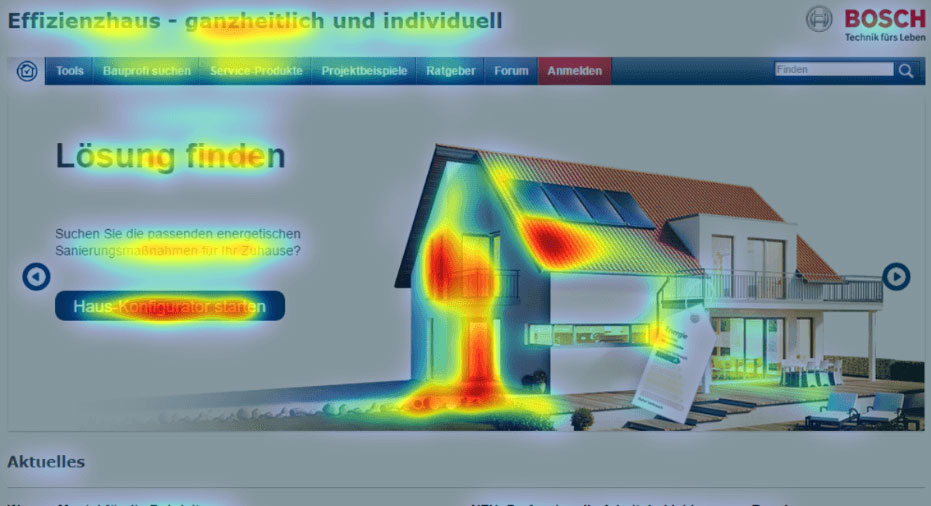

By combining remote and lab tests with eye-tracking, we were able to identify the areas that needed optimization to increase the conversion rate. We found Userlutions to be highly competent in their consulting services and flexible and reliable in their implementation.

Customer
Marie Nogueda, Senior Product Manager,
BOSCH Thermotechnik
Results
Understanding target audiences
Optimisation recommendations
Increasing conversion rates
Our approach
Userlutions is…

UX lab owners:
In our UX facility, we have everything we need for lab testing. For example, we’ve already tested washing machines and heating modules there.

UX testing experts
We’ve conducted thousands of UX tests and know exactly what matters when it comes to preparing for and conducting them.
Experienced from thousands of projects
Since 2011, we have been serving clients from a wide variety of industries and with a diverse range of products in both the B2C and B2B sectors, including Coca-Cola, Bosch, Adobe, HanseMerkur, Condé Nast, Check24, BMW, and many others.
What do you want to start with? Let’s talk!

Birgit Bärnreuther
Head of Consulting
+49 30 / 544 870 24
(Mon to Fri from 9 a.m. to 6 p.m.)
Birgit Bärnreuther
Head of Consulting
+49 30 / 544 870 24
(Mon to Fri from 9 a.m. to 6 p.m.)