
Designing an AI feature: from concept to prototype
UX services

UX research

UI design

AI strategy

UX testing

UX design

Consulting

Prototyping

The process was a real stroke of luck for us: focused, to the point, and always well-managed. In the end, we had a well-thought-out, tested concept that we were then able to translate directly into our MVP. This shows that a user-centered approach pays off even when it comes to AI products.
Customer
Johannes Nielsen
Founder
sommelier.bot
Online wine consulting that adds value and helps achieve business goals
We had the opportunity to be part of the redesign, testing, and development of sommelier.bot: a mobile-first AI wine advisor that turns a simple product search into an engaging experience. It’s not just based on hypotheses—it’s been tested and validated with real users.
Traditional online store filters require specialized knowledge. The sommelier.bot, on the other hand, helps users select wine, beer, and spirits while simultaneously driving qualified traffic to retailers.
The project’s goal: to further develop the existing AI functionality with gamification elements in a way that sustainably increases motivation, usage frequency, and repeat visits—for both wine novices and connoisseurs alike.
Two very different target audiences and a consulting approach that appeals to both
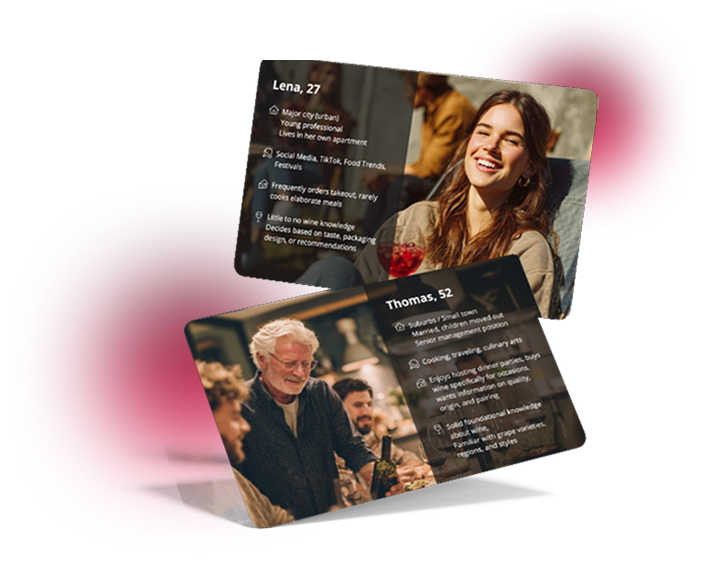
The biggest conceptual challenge lay in the conflicting needs of the target audience. An analysis of the users revealed two protopersonas, which we used as the basis for our concept:
- Young, tech-savvy wine novices browse extensively and make their decisions based on the label or tasting notes.
- Experienced wine connoisseurs expect transparent, clear recommendations—and not a “too simplistic” approach.
Added to this was a challenge inherent to AI projects: an AI interaction that did not yet exist had to be made tangible and testable. Unlike with traditional interfaces, there isn’t just one flow—rather, there are countless flexible usage scenarios that a prototype must be able to simulate. We solved this by creating an illustrative, clickable flow—realistic enough to elicit genuine user reactions.
At the same time, we consciously walked a tightrope between vision and feasibility: The concept was meant to anticipate future technical possibilities while still describing a product that already works today and delivers real added value.
From information overload to playful discovery
Research + design framework
We began by analyzing the target audience, purchasing behavior, and existing AI solutions in mobile commerce. From this, we derived five design principles and a clear design shift: away from knowledge-based filtering, text-heavy content, and pure chat, toward inspiring discovery, visual learning, and playful interaction.
AI strategy workshop
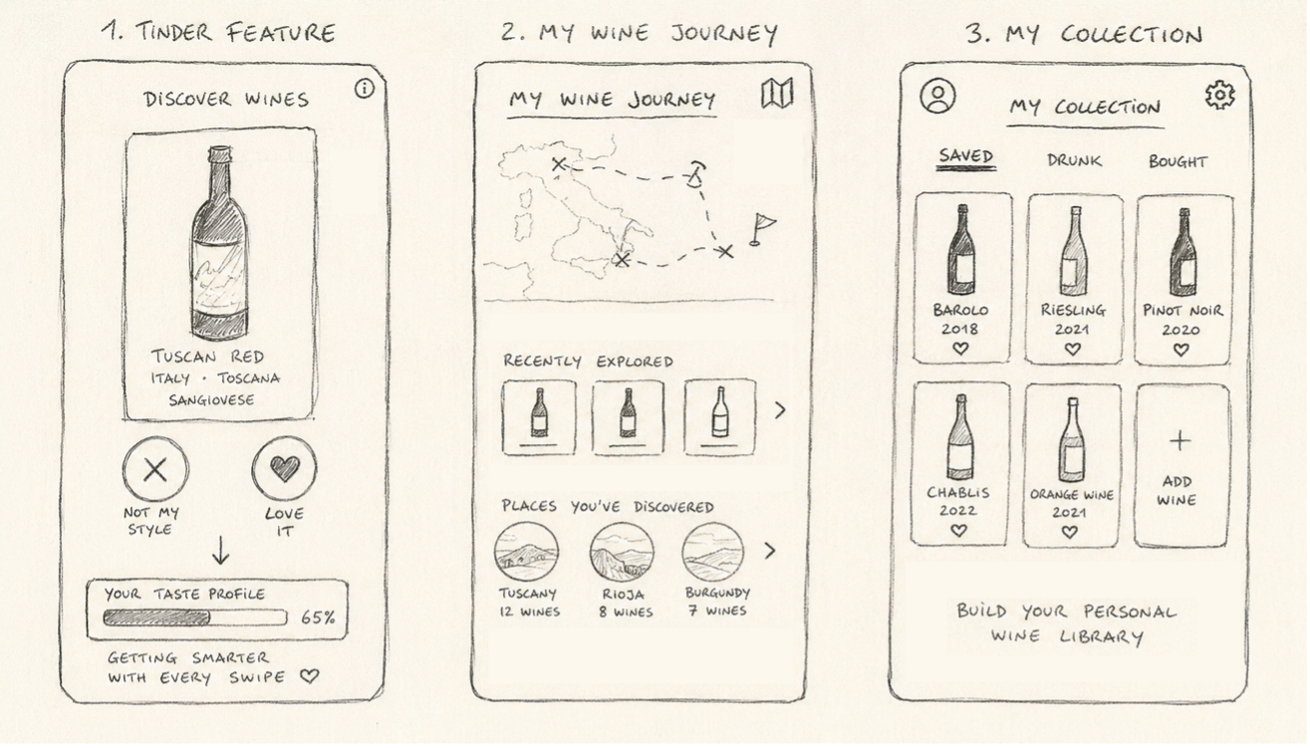
Using empathy maps, Jobs-to-be-Done, and design thinking methodologies, we developed interaction concepts and an initial customer journey for both user groups.
Concept + clickable prototypes
The scribbles evolved into wireframes and two prototype integration scenarios: a standalone app and integration into an existing retailer website. In the process, we developed our own design patterns and best practices for designing AI features that extend beyond this project.
User testing + iteration
We tested the concept with twelve people from both target groups in moderated sessions and revised it based on the results—before development began.
A solid foundation for further development
The result is a user-tested concept for a gamified, mobile-first AI wine advisory service. The focus is on interaction- and experience-oriented mechanics, the impact of which was confirmed in user tests.
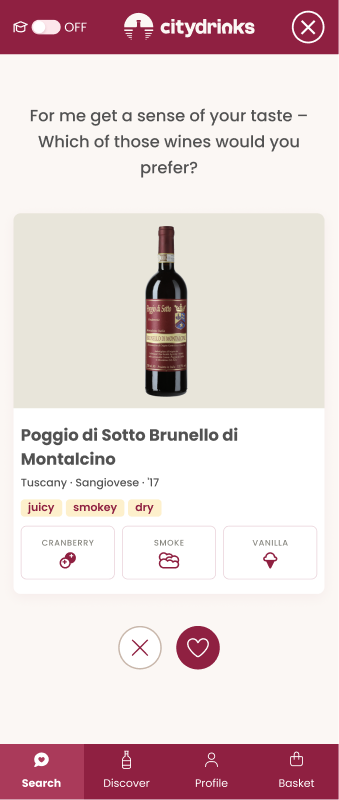
The swipe-based taste assessment appeals primarily to younger users. With every swipe, the AI refines the user’s personal taste profile. After every three swipes, it briefly asks what criteria were used to make the decision.
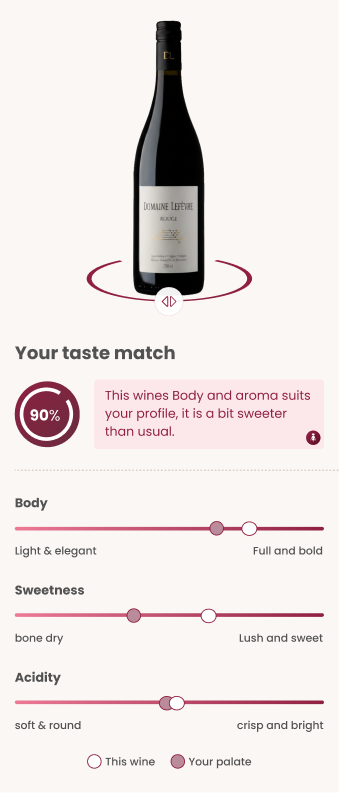
The Taste Match Score and the visual comparison of taste profiles and wines make recommendations easy to understand and build trust. Taking into account the occasion, food, budget, and number of guests gives users the feeling that they are understood.
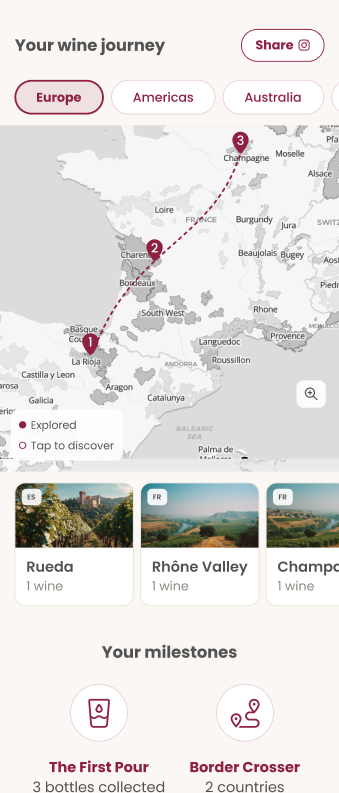
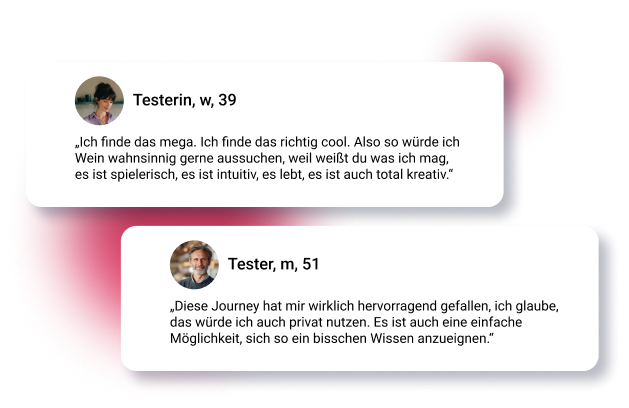
The interactive wine list and the personalized “Wine Journey” have just received very positive reviews from experienced users.
Successful AI products start with the people who use them
Instead of programming based on assumptions, the sommelier.bot team is moving forward with a validated concept. The MVP has now been built, and the design system is in the works. They will measure the actual impact—interaction rate, NPS, and repeat usage—during live operation; the foundation for this has been laid.
This project demonstrates what matters to us: AI products, too, must be designed with the user in mind from start to finish. Proven UCD processes are crucial here as well for turning a technical possibility into a product that people enjoy using.
Our services
Curious? Here’s how we can help you

AI strategy & planning
We work with you to identify use cases that create value and build them in a way that earns users’ trust. Research, strategy, design, and testing for AI products.


UX research
Get to know your users and their problems. We analyze the needs of your target audiences and test concepts with real users before writing a single line of code.

UX design
From the product vision to MVPs to the complete user interface: We develop digital products that delight your users while keeping your business goals in mind.
Where do you want to start? Let’s talk—no strings attached.

Birgit Bärnreuther
Head of Consulting
+49 30 / 544 870 24
(Mon–Fri, 9 a.m.–6 p.m.)
Birgit Bärnreuther, Head of Consulting
+49 30 / 544 870 24
(Mon–Fri, 9 a.m.–6 p.m.)