
Combine qualitative depth and quantitative certainty with DeepQuant
UX services

Needs assessment

DeepQuant

User research

UX consulting

Simple, efficient collaboration—and thanks to clear insights from DeepQuant, we can refine our positioning without having to throw everything overboard.
Customer
Koos Looijesteijn
Design Director
ForTomorrow

Starting situation
ForTomorrow helps companies and individuals offset their CO₂ emissions. Based on their own research, they knew that the term “offset” does not always have positive connotations, and they wanted to find out whether a different approach would be more effective.

Project objective
The goal was to evaluate different versions of the speech both qualitatively and quantitatively in order to make an informed decision regarding future word choice.

Result
Although the existing version received a higher rating, it also revealed some weaknesses—the next version can be specifically optimized for trustworthiness and clarity. Willingness to donate was also evaluated.


Instead of traditional A/B tests, we decided to conduct a DeepQuant analysis. This allowed us not only to recommend one of the variants but also to provide insights into why that variant performs better.

Qualitative methods provide deep insights into users’ motivations and emotions—though usually based on small samples. Quantitative methods provide reliable figures and allow for comparison, but they do not explain why people make certain decisions.
UX research is most effective when both elements come together—though in practice, this often requires a significant amount of effort.
That’s why we developed DeepQuant.

In a DeepQuant study, 50 to 100 participants test a product by completing specific tasks—accompanied by screen recording and a questionnaire that combines closed-ended and open-ended questions.
The quality of responses is three times higher than in standard panel surveys because the participants use the actual product being tested during the survey and are thus more engaged with the questions. They also answer the open-ended questions in much greater detail than in purely quantitative online surveys.

It takes a maximum of two weeks from the kick-off meeting to the presentation of the results. We present the results in a concise and easy-to-understand format—including specific recommendations.
The analysis follows a structured process: First, we analyze the quantitative responses, then the qualitative feedback. Screen recordings provide additional context as needed.
The insights gained not only help with product development, but also with effectively convincing stakeholders.
Testing and validating the effectiveness of language
ForTomorrow helps companies and individuals offset their carbon footprint. However, discussions and our own research have shown that the term “offset” is not viewed positively by everyone—and can raise doubts about its effectiveness or credibility.
Together with us, ForTomorrow wanted to find out whether alternative phrasing is more effective—and how that affects people’s willingness to donate.
The goal of the project was therefore to conduct targeted testing of different versions of the landing and donation pages in order to make sound, user-centered decisions regarding future communication.
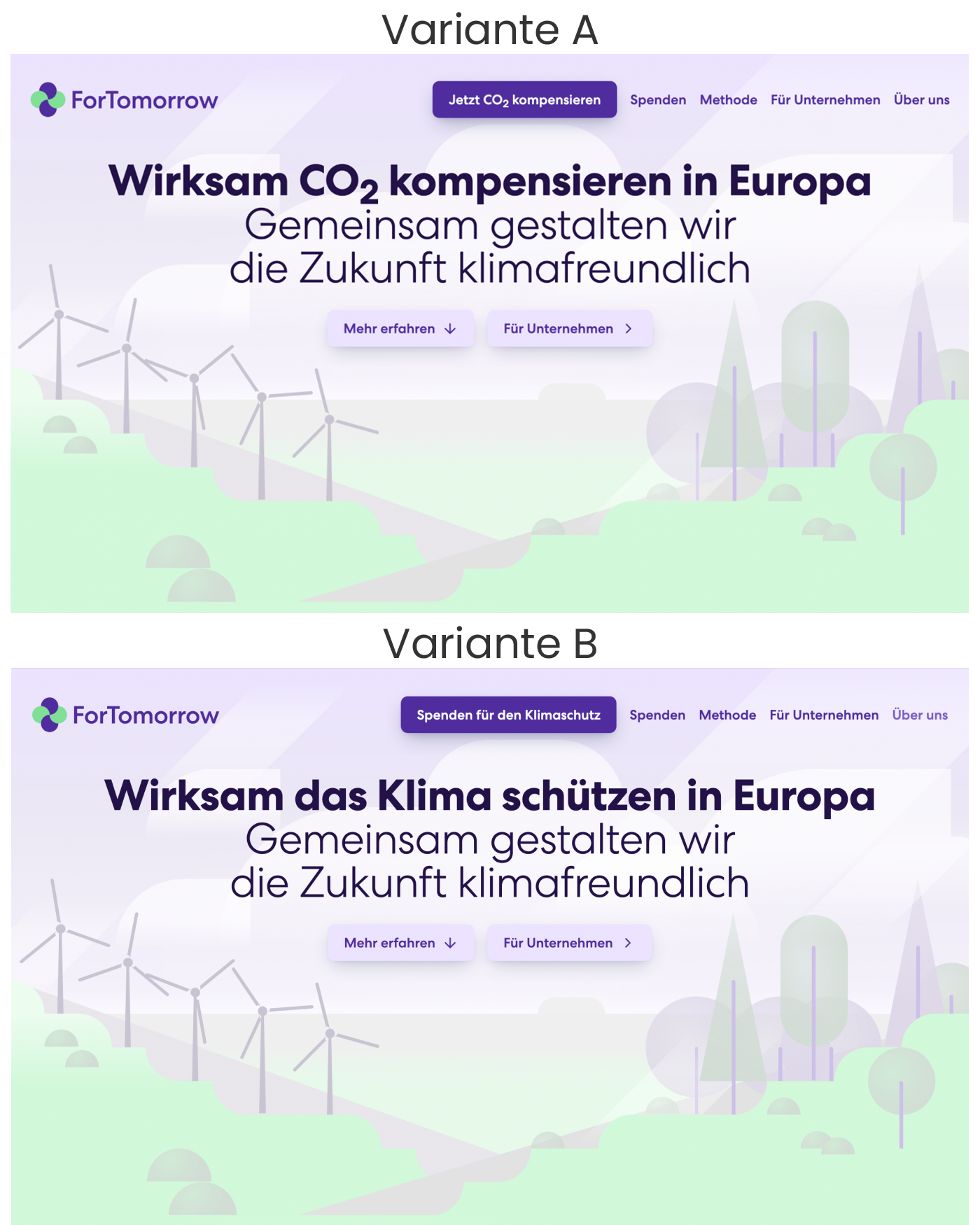
DeepQuant provides ForTomorrow with guidance on the next steps
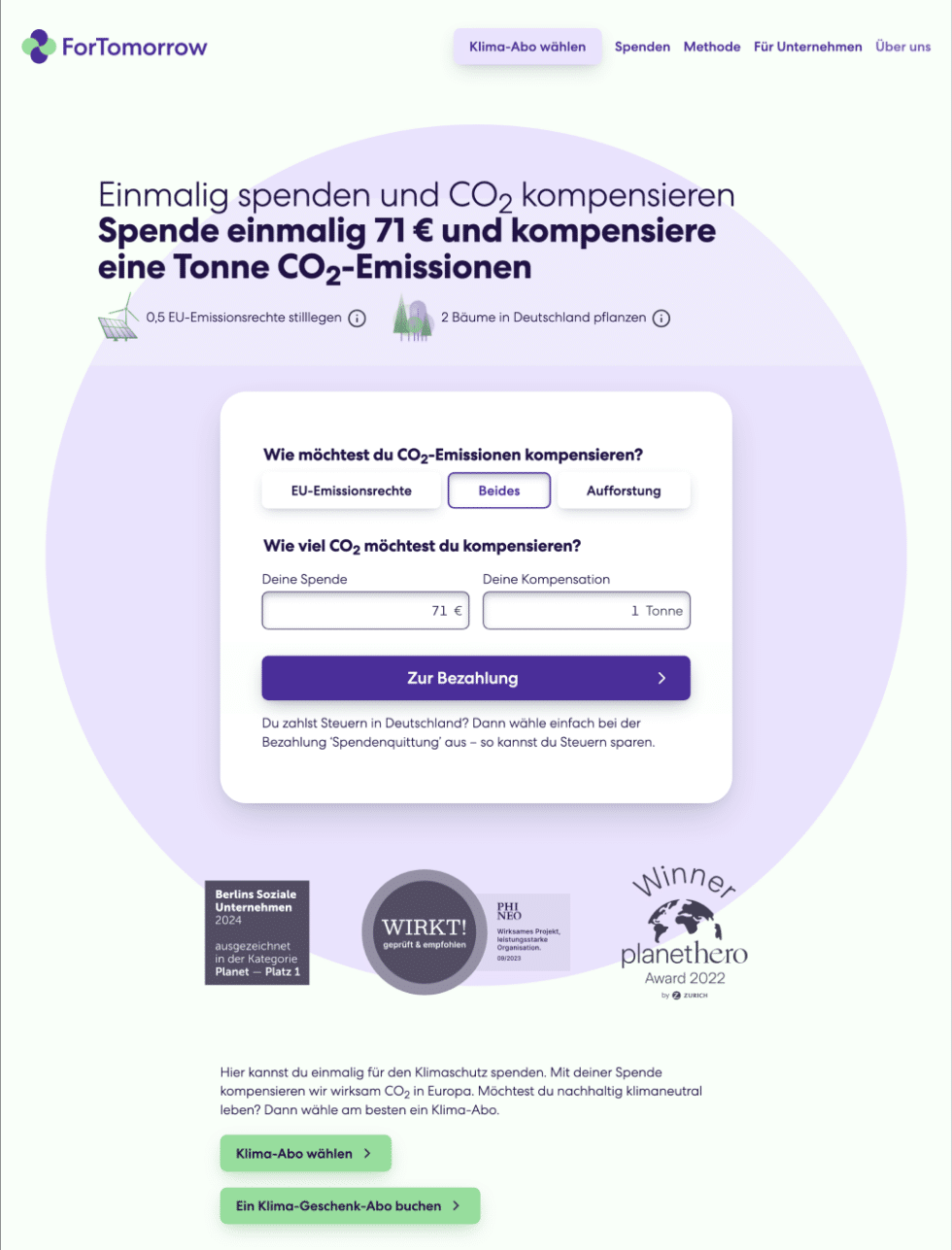
Based on two versions of the text for the home page and donation page, we developed a questionnaire that assessed not only comprehensibility and trust but also willingness to donate. Within three days, 50 people participated —selected from our own panel, which is particularly well-suited for qualitative feedback.
The result: The current version was generally more well-received. Only a few people viewed the term “compensation” critically. The new version performed less well in terms of trust—but provided inspiration for an improved version. The word “protection” stood out as particularly positive and is set to take center stage in the future. This gives ForTomorrow a clear basis for decision-making—and concrete strategies for further developing its communication.
Where do you want to start? Let’s talk—no strings attached.

Birgit Bärnreuther
Head of Consulting
+49 30 / 544 870 24
(Mon–Fri, 9 a.m.–6 p.m.)
Birgit Bärnreuther, Head of Consulting
+49 30 / 544 870 24
(Mon–Fri, 9 a.m.–6 p.m.)